Category: Philosophy
A summary of my proof of the existence of God
To summarize:
1. It seems to me that “it just is” is not a satisfactory response to the questioning why any World (universe, multiverse, whatever) exists, let alone one which includes conscious entities apparently capable of understanding it (or so much of it as we seem capable).
2. Science is not capable of providing a satisfactory response. (If you disagree, let’s hear it then. Because it certainly isn’t anything which starts by just taking quantum mechanics as a given because the laws of quantum mechanics are a part of the World giving rise to the question in the first place.)
3. Ideas (forms, in the Platonic sense) do not require any response of the type the existence of the World requires. They simply are, regardless of whether anything they refer to exists in any other-than-ideal manner. For instance, the idea that a square has four right angles can be said to exist in the way I am speaking, regardless of whether there exists anything which is not just an idea out of which to make a square. It is simply a logically consistent statement.
4. It seems to me that something like #3 could offer a satisfactory response to #1 and Max Tegmark’s concept of the World being an intricately detailed mathematical structure and that our particular universe is a substructure thereof. And further that we are yet lower level substructures which happen to be capable of processing information in a manner that is both sufficiently complex and yet still sufficiently unified as to have the subjective experience of consciousness.
5. To which I add that if our level of conscious substructures exist, then it would be sheer hubris to suppose, a priori, that no other such conscious substructures exist. I invoke the Copernican Principle in support of this conclusion.
6. #4 & #5 get us to the point where our minds should be open to the probability that consciousness greater than ours exists and as such (greater than ours I mean) we ought not expect it to be leaving evidence of itself where NASA can spot it. We should reasonably expect the evidence to be no more or less than what it would permit us to discern and I invoke all the usual theistic explanations for why that evidence would be subtle enough to preserve our moral agency and permit us the degree of autonomy that oppressively obvious evidence would not.
7. Thus, I conclude that a greater consciousness probably exists. I contend that such a conclusion offends no established scientific principle and is consistent with, even required by, the only plausible response to #1 above.
8. Having concluded, a priori, that this greater consciousness (“God”) exists, I would require a preponderance of evidence to the contrary to conclude that he does not exist. But on the contrary, although I do not see any reason why it must necessarily be so, I see evidence that there is a net positive degree of goodness and beauty in how we experience the World and this seems to me to be entirely consistent with, and best explained by, the existence of what to us at least would be an omniscient, omnipotent, omnibenevolent higher consciousness. The good life in a good World that most of us are able to enjoy, despite all the struggles and hardships it includes, or maybe even more because of how we are capable of overcoming them, is sufficient evidence to conclude, on the balance of probabilities, that God exists.
Why atheists should keep an open mind
The standard of proof in criminal cases is “proof beyond a reasonable doubt”. Some think of this as being about 90% or 95% sure of guilt. The scientific standard is higher because more precise data permits metrics to reach objective levels of 99.9% or higher. But in almost all cases where we need to assess evidence in order to make decisions, we employ the “balance of probabilities” test – is the thing more likely than not. I do think we employ this when it comes to deciding where to eat but I also think we ought to employ it when it comes to whether to believe in God.
Why? Because there’s the risk in being wrong is minimal and the price of striving for greater certainty is too high.
If we incarcerate an innocent person we do great harm and so we must be quite sure. Establishing a scientific tenet could be equally serious – think of the testing done on the Covid vaccines – plus, achieving greater certainty isn’t too costly.
When it comes to where to eat, we could conduct extensive research and decide that way but we don’t because it doesn’t matter if w get it wrong. So we’re happy to eat somewhere if we think it’s more likely than not to be a good choice.
When it comes to God, greater certainty than being more likely than not is probably unachievable at any price. Moreover, one is always at liberty to change one’s belief as one continues to weigh more and more evidence so there is little risk in erring. (I am not one who believes in a God who subjects atheists to eternal torture).
So, all that is to say that as I contemplate the amazing universe (multiverse) that we both know (a bit) and love (a lot), I believe that the explanation for why there happens to exist a set of laws that permit such a thing must lie in something apart from the universe itself. All I can think of that this could be is some kind of Platonic form – an idea. In this case, perhaps uniquely, an idea with creative efficacy.
Then I am amazed at how it is that we happen to be able to understand so much (potentially all) of this universe by way of mathematics. This makes me think that Max Tegmark is onto something when he posits that all logically self-consistent mathematical structures exist as these kinds of ideas or forms and that our universe is one of these of sufficient complexity to include substructures in the form of conscious observers (us).
If substructures can be conscious, couldn’t superstructures be also? Couldn’t there be a sufficiently complex, and yet sufficiently unified, mathematical structure as might constitute what we might think of as God of which we might be significantly less complex and unified, yet still conscious, partitions?
In the evolution of the cosmos and of life I see purpose, reason, causation – a point to everything. Not in every detail but to every process if one looks at it from a broad enough perspective. I think that our lives are what conscious mathematical substructures “feel like”. And if our level of conscious mathematical substructures exist, why shouldn’t more complex ones exist? I believe this because it explains why there is a universe, how it is that we can understand it as we do, and because it provides a point or purpose to it all that it seems to require.
I offer this, not as proof to the scientific standard, but on the balance of probabilities. To me, it is at least somewhat more likely than not. Once the door to one’s mind is opened this much, I believe it is possible that certain other experiences we can have can be understood as manifestations of that “divine” conscious, cosmic, mathematical superstructure.
I don’t suppose I’ve got all this figured out correctly, but I believe it’s plausible enough to justify keeping an open mind to the possibility, even the probability, that something along these lines might be the explanation for how things as objectively weird as us exist.
Unity is NOT the answer
Calls for unity from the left are actually calls for surrender. It is a call for conformity, for rule by consensus – an end to diversity of thought and freedom of speech.
Case in point: a literary agent is fired merely for having an account on alternative social media platforms and for supporting free speech.
If you want to surrender to the new fascism: rule by consensus, at least be honest about what you are doing.
There is a unity worth pursuing. It is to unite with those who share your values. Values of individual rights, of liberty, of free thought and freedom of expression, of respect for property and, above all, respect for life – meaning respect for each person’s right to live their own life the way they chose. These used to be called “liberal” values. That’s why it’s wrong to refer to the left as “liberals”. They are not “progressives” either. The left are actually conservatives, reactionaries who want to return to an era where social elites dictated the rules everyone was to live by. Advocating unity with such an evil is akin to dosing pure water with arsenic – it only takes a little to turn a life saving drink into poison.
Unite on the basis of shared principles. Life affirming and life enhancing principles. This unity requires that we disengage with those tyrants of the left who insist we let politicians, celebrities, corporatists, big tech, and big media do our thinking for us.
If you want to preserve and even increase your personal freedom, disengage the state and its lap dogs. Unite with those who share your values on alternative platforms. Yes, there will be terrible people there as well. But do what people who respect the rights of others should always do – discriminate. That is, you be the judge. You decide whether something is right or wrong, good or bad, correct or incorrect. Exercise your moral agency.
True Doctrine
I just noticed a Facebook post that I made a couple of years ago on this topic. I still like it but would like to modify it slightly so I am restating it below, slightly updated.
A word respecting official LDS doctrine. There is no official church doctrine, only an official source of doctrine – the standard works – scripture. And even that is an oversimplification as it isn’t even scripture per se but the revelation that comes when seriously contemplating scripture. True doctrine is received by revelation, which “distills upon our souls as the dews from heaven” (DC 121), as we contemplate scripture. True doctrine revealed as part of a process that includes scripture. The role of scripture is not to recite or contain true doctrine but to facilitate the revelation of true doctrine.
Some, unfortunately, consider attempts to articulate the results of such contemplation “idle speculation”. But there is nothing idle about the process – neither is it merely speculative, necessarily. It is intellectually challenging and the quality of the result, and ensuing satisfaction derived therefrom, is commensurate with the effort. Ironically those who oppose such “idle speculation” are idolaters. Their intent is to preserve the purity of the doctrine they mistakenly believe the scriptures to contain. But instead they raise the uncontemplated words themselves to the level of a false idol. “A Bible! A Bible!” (2 Nephi 29).
Or, just as unfortunate, they point to someone else and accept their articulation of doctrine as authoritative. “If so and so says it, it must be true.” This raises “so and so” to the level of mediator between the slothful servant and God. Any attempt to articulate truth must fail, at least in some measure, due to the inherent imperfection, or imprecision, or inadequacy, of words, being mere symbols. Our unarticulated concepts are far from perfect representations of reality but their accuracy is diminished further when they are articulated.
All this is really to say that the old advice that if you want the truth you ought to seek it in the horse’s mouth applies. As we contemplate the word of God, not only written in scripture but also as written in nature, we can glimpse the truth in its purest form. Then we start fitting it into our flawed concepts and some of that purity is lost. Then we try to articulate it and the glass darkens further.
That’s not to say our contemplation can’t be improved by including the relevant views others have articulated. But these absolutely must be taken as an aid to our own contemplation and not as a substitute for it.
Never cease to contemplate (not just read) the articulated word of God because, if you look beyond the words themselves, the Spirit will reveal the truth. “And by the power of the Holy Ghost ye may know the truth of all things” (Moroni 10).
The Truth about Truth
A member of our church (The Church of Jesus Christ of Latter-day Saints) once objected to what he perceived to be the impossible level of certainty expressed by others:
“I don’t like it when people stand in testimony meetings and say, ‘I know.’ You can’t know stuff like that. You can believe or have faith, but you can’t know!”
But in John 8:32 we read that Jesus said
“Ye shall know the truth, and the truth shall make you free”.
And again in John 17:3 Jesus asserts:
And this is life eternal, that they might know thee the only true God, and Jesus Christ, whom thou hast sent”
These statements by Jesus made it clear that:
it is possible to know things
to know God is eternal life, so its pretty important that we do know things
But doesn’t the member I quoted make a valid point? We can’t really know anything for sure, right?
Consider how we come to know the things we say we know. The everyday things. We might say that we know that the sun is in the sky. Why? Because we can look up and see it. It’s right there. But what’s really happening?
Deep inside the sun physical processes create a tiny package of information called a photon that makes its way to the surface and then flies to earth at the speed of light where, eight minutes after it leaves the sun, it pierces your cornea and slams into your retina at the back of your eye. That excites your optic nerve which sends an electrical signal all the way to the back of your brain where your brain cells interpret the signal as a flash of light.
But one photon isn’t enough to register with our conscious mind. It takes many of these photons slamming into our retina before our brain discerns a familiar pattern, a circle, a circle of light. That pattern, coupled with the pattern of impulses that our brain recognizes as meaning that our head is raised and we are looking up into the sky, is interpreted as meaning we are looking up at the sun.
But notice that we don’t experience the sun directly. We only experience the photons, the little packages of information, directly. It’s our repeated experience of interacting with similar photons in similar ways that our brains interpret as seeing the sun. Repeatedly experiencing patterns like this is how we come to know things.
But are the things we experience in this way really there? Do we know these things with a perfect knowledge just because we say we see them?
In 2015 The Dress became an Internet phenomena. It was a picture of a dress which some people saw as being white with gold trim and other people saw as being blue with black trim. People saw different things, even though they were looking at the very same picture.
In 2018 two brief audio clips became famous for similar reasons. Listening to one clip some people heard the name “Yanni” while other people heard the name “Laurel”. Their experience was different even though the sound itself was the same.
Another clip sounded like “brainstorm” to some and “green needle” to others. There was no trickery at play in any of these examples. So was the dress white and gold or blue and black? Neither. Different people perceived these phenomena differently because of subtle differences in the way their brains interpreted the input they were receiving.
The other day my wife mentioned that we had pecan pie and gestured to the pumpkin pie that was sitting on the kitchen counter. “What kind is it? I asked. “Pecan,” she replied. I raised an eyebrow. “Pumpkin pie was on sale so I bought one,” she explained. “But you said it was pecan,” I said. “No, I said it was pumpkin,” she responded.
Now the thing is, pecan pie is my favourite and I dislike pumpkin to the point that I won’t even eat it so the distinction was very important in my mind so I’m sure I was right. But we both were “sure” we were right, even though we couldn’t both be right.
My point is that sure, perfect or absolute knowledge is not a characteristic of human experience, regardless of how many times you may hear people lay claim to it. Neither the everyday things we say we know nor the more abstract truths discovered by careful study and thoughtful reflection can achieve the level of absolute certainty. There is always room for self-delusion or to be deluded by others. For our minds to play tricks on us
But that doesn’t mean that those of us who testify of eternal truths are mistaken when we say, ” I know that the gospel is true.” Repeatedly experiencing patterns of cause and effect can justify increasingly confident assertions. And that’s what these claims to knowledge really are – ways of expressing our high confidence that our declarations of truth are accurate.
Alma can help us understand what we mean when we claim to “know” the truth. Alma famously speaks of conducting an experiment. “Experiment upon my words,” he exhorts us in 32:27.
He says the experiment is like planting a seed and watching to see if it grows. It it grows, it is a good seed. If it doesn’t grow, it is a bad seed. All you need to have to begin the experiment is two things:
- A seed
- A desire to know if the seed is good – an inquiring mind open to accepting the truth
Now if you just don’t care about whether the seed is good or bad, you won’t even bother conducting this experiment. You’ll find something else to do. But if you do want to find out, you will plant the seed and watch and if it grows, then you will have as close to a perfect knowledge as its possible to have that this was indeed a good seed.
Now I’m not sure whether Alma was a farmer but I do know he was a missionary and that this experiment he spoke about wasn’t really about seeds. His invitation was to “experiment upon my words” as he taught gospel truths.
This experiment is not just for non-members who want to know whether the gospel as taught by our missionaries is true. It applies to all of us, regardless of how few or how many years we’ve been members of the Church. It applies to any bit of new information we want to know the truth about whether we hear it from someone, or read it somewhere, or it just pops into our mind.
So remember the two things we need to begin the experiment? The seed can represent any information. Our desire to know the truth is the other thing we need because without that desire, we will never find the time or energy to plant the seed.
What does it mean to plant the seed? How do we plant information? What soil do we plant it in? We plant it in the soil of our lives. We begin to live as if we already knew that the information was true and we see how it affects us.
Alma says that if the information is true, it will begin to:
- “Enlarge your soul”
- “Enlighten your understanding”
- “Be delicious to you”
What can these things mean? What do they mean to you? To me they mean that truth leads to more truth. Truth helps me understand other truths more clearly, more deeply. Each Truth helps me see how all Truths fit together as pieces of a great puzzle – a puzzle I yearn to complete and help others complete.
Discovering truth is delicious. It makes me feel great, happy, that the little things that go wrong in life don’t matter because I know the truth and, as Jesus said, the truth sets me free from those little unimportant things.
I remember when I was little my father built a sandbox for us in our backyard. I would play in the sandbox with my friends, making roads and buildings. and pretending that what we were doing was important. Because that’s what kids do when they play. They practice being adults by pretending to do important adult things. They might seem silly to us but to kids play is serious business.
Once in a while I would catch a glimpse of my mother peeking at us from the window, just unobtrusively watching over us, but ready to intervene should we get carried away with our play and take it too seriously. Imagine, getting upset because someone ran his toy car into your little sand house. At that age it could start a fight but now it seems hilarious that we’d attach such importance to sand.
I often think of how my old sandbox story is analogous to our adult lives. We might think of ourselves as vastly more sophisticated than our children but to Heavenly Father we are all still children. Whenever I catch myself getting worried or upset about things I remember that, in truth, Heavenly Father is watching over us, ready to intervene if needed and that in reality we are still just little kids playing in the sandbox he built for us, pretending that what we do is important, when it is really only just practice for the important work of eternity. This truth sets me free.
We worship truth. We sometimes capitalize the word Truth because it is one of the names for Our Saviour who said, I am the Way, the Truth, and the Light. (John 14:6)
Oh say, what is truth? ‘Tis the fairest gem. Priceless in value. The brightest prize. An aim for the noblest desire. The pillar of truth will endure to the last for ’tis the last and the first and tho the heavens depart and the earth’s fountains burst, Truth, the sum of existence, will weather the worst, eternal, unchanged, evermore.”
All these words from that great hymn describe Truth and He who exemplifies Truth. We are by nature attracted to truth. DC 93:29 tells us that our essential nature consists of light and truth. So when we hear the truth, read the truth, plant the truth in our hearts or, in other words, live our lives in a manner consistent with the truth, we will feel it and know it to be truth. It will enlarge our souls, enlighten our understanding, and be delicious to us. The Savior taught that: “If any man will do his will, he shall know of the doctrine” (John 7:17).
Notice that Alma says the truth will “begin” to feel this way to us. We needn’t think we will experience a sudden overwhelming awareness of truth. That may happen, but it is more likely that our appreciation for the truth will grow gradually – like a tree that emerges from a seed grows.
In vs 37-39 Alma tells us that as the tree begins to grow, or in other words, as we begin to feel the positive effects of living the truth, we need to carefully nourish the tree so it takes root and produces fruit. Because, if we don’t, it will not take root and the sun will wither it away. If that happens it won’t be because the seed was bad, but because we failed to nurture it.
And how do we nurture the truth in our lives? President Gordon B. Hinckley said that every member needs “a friend, a responsibility, and nurturing with ‘the good word of God.'” Full participation in the Church will provide all of those things and be the means by which we constantly nourish our little tree of faith and ensure that it grows and bears much good fruit.
Brad Wilcox described the way we can obtain a knowledge of the truth in this way:
“We gain a testimony through experience as we participate in the Church and interact with other members. We attend classes and activities. We go to sacrament meeting, where we partake of the sacrament. We worship the Savior and learn of Him. We sing hymns, prepare and give talks, and participate in interviews. We know what it is like to live as Latter-day Saints because we have experienced it firsthand. And though we may not always recognize it, the Spirit is there, which helps us receive knowledge.”
It is often said that when we pray, we speak to God and when we read scripture, God speaks to us. But I say it is not by simply reading scripture that revelation comes. We need to nourish the seed of truth that we find in the scriptures by acting upon those truths. Doctrine & Covenants 121:45 promises that the doctrine of the priesthood will distill upon our souls as the dews from heaven as we live charitably and virtuously. We must learn, and then we must do, and only then will we know.
To seek and expect an absolute knowledge is to look beyond the mark. But we don’t need a philosopher’s standard of knowledge, we need a carpenter’s, or a farmer’s. We don’t need certainty. All we need is to experience the yield of good fruit from gospel living to experience the Spirit’s gift of overwhelming joy that accompanies and confirms the truth when we declare, “I know the Saviour lives.”
Can a god be bored?
Point 1: We can make computers that do more than one thing at a time (parallel process or multitask). God is omnipotent. Therefore, God can multitask.
Point 2: We get the most happiness by overcoming challenges. When we don’t have any, or when those we have are being particularly difficult to overcome, we invent some (games, sports, etc.) In these invented challenges we typically submit to rules which limit what we can do to achieve the goal.
Putting these two points together, when we, as gods, get bored, why won’t we use our ability to multitask to use a part of our consciousness to continue working (bringing to pass the immortality and eternal lives of our own spirit children) while using another part of our consciousness to overcome an invented challenge?
I imagine myself reliving particularly enjoyable experiences. Further, I imagine that I will restrict the access that part of my consciousness I assign to reliving the experience has to my memory so that as I relive the experience it will seem to me that I am not reliving it but experiencing it for the first time. Imagine experiencing your first date, your wedding day, the birth of a child, over again, as many times as you wish, but not merely as a memory but as if it were happening for the first time.
What about that game winning shot you made? That overtime goal? The day your business started to make a profit? That painting you finished? The book you wrote? We’ve all had so many experiences where we had that irreplaceable sense of accomplishment for having successfully overcome a significant challenge. Reliving them but as if for the first time could relieve an eternity’s worth of boredom.
What about tweaking those memories a bit to improve them? What if you missed that last second shot and lost the game? This time you make it. With part of your mind you simulate what the rest of your life would have been like had you made that shot while another part of your consciousness experiences that newly simulated life, or as much of it as you wished, as if it were real. (And why wouldn’t it seem just as real as your real life? And if it seems just as real, why wouldn’t it actually be just as real?)
Modern video games let you assume the role of a basketball star playing through an entire season or even an entire career. Couldn’t a god simulate the same thing only in perfect full immersion virtual reality down to the most exquisite detail? And if you enjoyed basketball in this life, and were now a god, and could multitask so you could do your work while simulating a basketball career, why wouldn’t you? The only reason not to would be because you had something even more enjoyable to do.
So, if reliving, as if for the first time, your most joyful experiences, or creating new joyful experiences for yourself and experiencing those, always as if for the first time, is the least fun you can have as a god, while concurrently being able to share this delightful mode of being with your spirit children, I conclude:
Conclusion 1: Gods don’t get bored.
Conclusion 2: Maybe you are already a god and this is exactly what you’re doing right now, in which case, you may be in for a very, very exciting day!
A dream within a dream
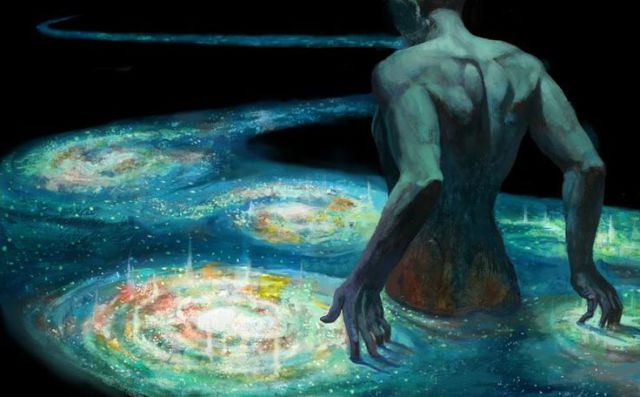
I just had an experience I want to make note of for its philosophical import. Steve Day and I were driving somewhere in my car discussing philosophy. At one point Steve asked me how I knew that this experience I was having at that moment was not a dream. After contemplating for a moment I replied that I knew it wasn’t a dream for two reasons. One was that nothing wacky was happening as it so often does in dreams. The second reason was a bit deeper.
I presume we have all had that experience, upon waking from a dream, of being somewhat amused, or at least surprised, at our own dream-state gullibility. How could our dream-self have seriously believed the dream was real when, recalling the dream now, it was clearly different in quality from “reality”. Not just because of the presence/absence of wacky components, but just because it seems that dreams are somehow shallower than real experiences.
Thinking about Steve’s question, the second reason I gave for my confidence that this experience was not a dream was that I had considered what I just explained in the paragraph above and I can tell the difference between what a dream feels like and what reality feels like and this experience was clearly a real one and not a dream.
Then I woke up.
The experience had been a dream. And in the dream I had thoughtfully, introspectively, considered the difference between dreams and reality and determined that the experience felt like the latter, not the former. If asked I would make the same assessment now of my experience writing this, just as I am sure you would of your experience of reading it. My dream suggests there is absolutely no justification for placing any confidence in such assessments. In fact …
Upon awaking I also realized that I had had at least one other dream through the night. It was also of the non-wacky variety – swimming at a beach in Florida. I recall that it seemed real enough to my dream-self. So, I now have three experiences to assess: 1) swimming at the beach; 2) the discussion in the car; and 3) writing this note. Yes, of course, the third now feels to me like reality where the others now feel like they were dreams but to put any stock in that fails to learn the lesson of the second experience. How can I be sure that I won’t awake from this dream and feel about #3 precisely the way I do about #1 and #2? I can’t.
In fact, given that I had 3 experiences, during each of which I was utterly convinced of its reality, and given that I now consider 2 of them to have been dreams, why should I not conclude that more of my experiences are dreams than are real? Surely on average we have more than one dream per night.
People often say this kind of thing doesn’t matter. I disagree. No, I don’t think that the conclusion that what I am now experiencing is probably a dream should lead me to act immorally or amorally or not act at all. Whatever this experience is, why not make the best of it? Why not make the best of me, in it? In fact, the conclusion that there is likely a “real” reality above or beyond this one instils a level of confidence, a boldness, to my decisions, since I don’t believe anything bad that happens is permanent. I believe the consequences of bad things can be fixed and that both the fixing of bad things and the doing of good things develops one’s character – it makes me feel better about whatever that thing is that I call “me”. Whatever that is, it seems to be the only think I can be sure about persisting from one experience to another and thus, the thing I ought to care the most about preserving and improving.
That said, I consider those others who seem to persist from one experience to the next to be integral to my self improvement and preservation. Happiness is the prime motivator. Efficacy is the prime source of happiness. If literally all of my decisions were of literally no consequence, it would be as if I did not exist. Efficacy is proof that I exist (self-preservation) and am capable of self improvement. The value of others to oneself is as of mirrors to our characters. When we see a happy person pursuing the same values as our own, our appreciation for the efficacy of our own value-based actions is reinforced and we experience happiness. We love those with who we share values. We are happy when those we love are happy because their happiness reinforces and reassures us of our own efficacy.
Since Einstein we have come to realize that much of the physical world that we thought was absolute is actually relative – they only exists in relation to other existents. Perhaps we are the same – needing others in order to truly exist. I’ll need to think about what I really mean by that later. Certainly our happiness is contingent upon receiving some feedback regarding our efficacy and I don’t know how we could receive that feedback except through our association with others in whom we recognize shared values. (This and the previous paragraph as inserted simply to temper and contextualize the last sentence in paragraph above them.)
All for now. I have to get some work done … for the self preservation and improvement of my character, my sense of efficacy, the happiness of those in which I recognize shared values – in short, for my happiness’ sake.
Note:
I am not dismissing other types of experiences, such as when we experience what we consider to be waking from a dream and recalling that, while dreaming, we were aware that we were dreaming. I am not suggesting that we never experience what we usually think of as dreaming. I am only questioning whether we can be sure that what we think we experience as a qualitatively superiour state of wakeful consciousness is really any different. Our recollection of a dream is certainly as of an inferiour experience, but our actual present experience of dreaming may very well be identical to what we experience as wakefulness.
Truth is Truth
Just completed a survey about a BYU exhibit and wanted to record a couple of my answers.
Q. How do we gain knowledge of truth?
“Revelation and scientific discovery represent complementary approaches to learning truth. Although there are significant differences between them, there are also many similarities in the processes they follow. For example, the process of revelation starts with faith in God, but also requires study, action (i.e. “experimenting upon the word”), and prayer. Similarly, science often begins with a hypothesis, and then conducts experimentation to test it. Whether truth comes from a scientific laboratory or by revelation from the Lord, it is all compatible because God is the ultimate source of all truth.”
I don’t actually think that revelation and science represent different means of discovering truth. In both cases we gather evidence by observation, we form a hypothesis, and we test that hypothesis by establishing parameters, changing variables, and observing results. In both cases we receive what we suspect may be truth, we tentatively accept it as being truth so that we may act on it as if it were truth, and we assess the resulting changes we experience as a result. The first statement uses scientific terms and the second uses terms language more likely to be heard in church. They both describe the same process. Through Joseph Smith we learned that there is no such thing as immaterial matter (sounds pretty obvious). The Holy Ghost has a body of spirit that He may dwell within us. The heart is not an organ of sense or cognition. His touch is the touch of mind to mind. And that touch is sensory input like any other and subject to the same evaluation. Just as all truth may be circumscribed into one great whole, so may the process by which that truth becomes known.
Q. How can we make sense of evolution in light of the restored gospel?
The LDS Church has no official position on the theory of evolution. “Organic evolution, or changes to species’ inherited traits over time, is a matter for scientific study. Nothing has been revealed concerning evolution. Though the details of what happened on earth before Adam and Eve, including how their bodies were created, have not been revealed, our teachings regarding man’s origin are clear and come from revelation.” (New Era, October 2016).
Whether an individual accepts or rejects evolution has no bearing on the truth of the restored gospel nor an individual’s eternal salvation. Church members may hold a range of beliefs regarding evolution. There are many faithful positions that individuals may take to make sense of evolution in light of the restored gospel. Many LDS biologists accept evolution and have formed an integrated view of how it is compatible with revealed truth, while other members do not accept evolution.
Evolution and creation need not be seen as mutually exclusive ideas. Through the restored gospel, we understand that God created and prepared the earth for a specific purpose: to provide the conditions where His children could receive a physical body, learn and grow through mortal experiences, and ultimately progress to become like Him. Pairing this knowledge with what we know through science about the history of life on earth can help us more fully appreciate and reverence our God for the incredible care and the love that went into the preparation of the Earth for mankind.
There is much general talk about the fact that human evolution can be reconciled with a literal Adam and Eve but little by way of specifics. I believe that is because if anyone ever got into how they may be reconciled they would be quickly shut down by a creationist or a teacher wanting to avoid contention. In the meantime, the lack of specifics about how to accomplish this reconciliation can leave some faithful evolutionists with an unnecessary crisis of faith. There is nothing speculative about this topic and there is no “deep doctrine” to avoid. It is simply a necessary part of the search for truth to participate in a discussion that aims to reconcile allegedly conflicting facts.
The Reality of Our Simulated Reality

“Everything is “real” if you experience it. And a simulated universe is as real as the universe that simulates it because reality is defined by the information it represents — no matter where it’s physically stored.” So says Maxim Roubintchik in “We Might Live in a Virtual Universe — But It Doesn’t Really Matter“, and I agree. It is unfortunate that people tend to dismiss the simulation hypothesis upon first encounter because they fail to grasp that it doesn’t in any way diminish the reality of what is being referred to as a simulation. And it’s not really their fault because there is usually so much to get your head around that this conclusion is inevitability left until fairly late in the discussion. But by then many have already established their bias against the proposition. Once that happens most are not open minded enough to reconsider their antagonism. Oh well, there’s still the rest of us.
Roubintchik makes the case well and so there’s no need for me to go on about it. I just wanted to heartily endorse his conclusion and add that it matters. It matters. Reality is real whether it can be thought of as simulated or not. But that it is likely simulated does have implications for many fascinating questions. One of them is the Fermi Paradox, which is very thoroughly explained in this article by Tim Urban. Aaron Frank, in “Is Virtual Reality the Surprising Solution to the Fermi Paradox?” offers the simulation argument as a possible “surprising solution”. This is sort of what I’d concluded some time ago. He says:
“If technology trends toward a world of microscopic computers with infinitely complex realities inside, this might explain why we can’t see any alien neighbors. They’ve left us behind for the digital wormholes of their own design.”
Why colonize outer space when inner space is so much larger, richer, and accessible? Seriously, why? I mean, maybe someday a few million years before the Sun is ready to swell up and swallow us, then we’d want to relocate at least to the outer reaches of the solar system. And then again billions of years later when universal heat death becomes a thing we might decide we need to squeeze every scrap of computronium out of it in order to achieve something like the Omega Point.
(If we really do need to achieve the Omega Point and if achieving it does require a universe full of computronium then we’d better be right about there being a whole bunch of similarly simulating civilizations out there because we’d all need to pull our heads out of the simulated sand at around the same time and work together to build said Omega Point as too much of this potential computronium will have sailed over the horizon of our respective visible universes for any of us to do it on our own. It’s unlikely that a disaster so remote in time would galvanize us to expand into outer space much sooner.)
I said that Frank’s conclusion was “sort of” like my own because he is suggesting that there are scads of equally or more advanced civs out there, all of which are foregoing outer space for inner space. But I think he is picturing them as “out there” in our universe. But our universe is likely one of the virtual realities occupying our own inner space, or at least our descendant’s inner space, though I think the former is more likely as who has better motivation to simulate our lives than we, ourselves.
In my view the 2 trillion galaxies, each with hundreds of billions of stars and trillions of planets that we see in our telescopes, are just elaborate desktop art for us. We are alone in our universe. What saves me from crass geocentricity is my conclusion that there are countless other universes, corresponding to the simulated backdrops of similarly simulated and simulating civilizations.
So, where are the other civilizations? They aren’t merely “up there” but preoccupied. They are literally out of this World.
Do gods reason?

This speculative piece assumes that our omniscient, omnipotent, omnibenevolent God did not merely create pets, but children, and intends to raise his children up to be just like Him, so long as His children do not reject His efforts on our behalf.
An argument goes, since gods are omniscient, there is nothing left for them to figure out. Reason is redundant since they already know everything, they only need recall it. Even recalling it is unnecessary since all would be continually before them. I think the capacity to reason essentially defines us. If we stop reasoning, we cease to exist as the type of being that would make me think that our being is truly eternal. If you say to a rather intelligent dog, “you will live forever, but you will do so as a cat,” I believe the dog is justified in thinking his days are numbered. But I think we can have our cake and eat it too.
Consider what we do when we find ourselves with a moment of free time, free of the cares and concerns of work, etc. Typically we devise another problem to solve. Maybe its engaging in a discussion on the nature of God. Maybe its to play a video game or a sport. We’re not happy unless we are overcoming yet another challenge. It is more than what we do, it is what we are.
Consider what a sport is. It is an artificial contest, either with another or others or even with ourselves, to achieve a goal within a set of rules which place restrictions on our ability to achieve the goal. That last point is my main one. If the only objective was to get the ball over the goal line it is easy to accomplish. I could do it against an all star team of professionals. I’d just drive the ball down the field in my car. But that’s no fun. The fun is in the challenge of restricting the ways you can accomplish the objective and still accomplishing it. The fun is in the challenge of voluntarily limiting your capacity.
I’ll skip right to my conclusion. I think that, as gods, we can and do employ 100% of the necessary power, knowledge and concern to the task of raising another generation of gods. And that we do it repeatedly, perhaps even multiple generations at once. However, with at least virtually all power and knowledge, surely we would have the ability to be simultaneously engaged in other pursuits. Unlike mortals, as gods we can multitask. We can walk and chew gum at the same time. We can devote 100% of the necessary attention to the prayers, concerns and activities of each one of billions of spirit children and still be able to devote 100% of the necessary attention to spending time with our own generation of gods – our eternal families, friends, etc.
And what would we do with our fellow gods? I suspect we would do the godlike equivalent of writing poetry. Consider what a poem is. It is the means of communicating more than dictionary defined meaning but also emotions by placing artificial restrictions on the way you assemble words. It is similar to a game. Watching ballet is like watching poetry in motion. Watching a running back elude tackle after tackle as he desperately hurls himself toward the goal line is also like poetry in motion. Watching a poor but determined individual lift himself out of the gutter to become a successful businessman is laden with the same emotional impact despite the challenges overcome being somewhat less artificial.
The poetry, the beauty, is in overcoming the challenge. Are gods no longer capable of beauty because there are no challenges left? Or do they, like we, invent challenges by artificially restricting their abilities in order to create such challenges? Even when nothing needs to be overcome, does the need to create beauty go away? If the need, does the desire? The appreciation?
How often we watch someone perform some amazing feat and exclaim, “Wow, I would love to be able to do that.” As gods, I suspect we will. We will create the challenge by place restrictions on that part of our consciousness which we devote to meeting the challenge. The beauty, the satisfaction, of using our rational capacity to overcome challenges will be how we, as gods, retain our essential natures.